|
Genetic variants in genes encoding L-type voltage-gated calcium channel (L-VGCC) subtypes are associated with increased risk for schizophrenia. Likewise, epidemiological study has implicated developmental vitamin D deficiency as a risk factor for schizophrenia. In the latest study published in Translational Psychiatry, we (led by Prof. John McGrath of QBI, UQ and Aarhus University, Denmark) showed that the active vitamin D metabolite exert a rapid, non-genomic modulation of L-VGCCs in a subset of neurons in developing medial prefrontal cortex in mice. Optimal modulation of L-VGCCs by 1,25(OH)2-vitamin D may therefore contribute to the healthy development of Vitamin D-responsive neurons within the maturing cortical circuits.
A collaborative study led by a PhD student, Eunice Wong from the Degnan's Labs (School of Biological Sciences, UQ), has revealed ancient submodules of co-expressed "synaptic gene" orthologues during development and in cell type-specific manners. Although synapses do not exist in the sponge, these submodules may contribute to sensory roles in specific cell types in the sponge. The paper was published in the journal Scientific Reports.
Syntaxin1A neomorphic mutations promote rapid recovery from isoflurane anesthesia in fruit flies22/7/2019
A collaborative study from the van Swinderen laboratory (QBI, UQ) published in Anesthesiology, has shown that transiently expressing a truncated syntaxin1A (Δ227) in adult Drosophila flies facilitates recovery from isoflurane anesthesia. Interestingly, our biochemical study revealed that the truncated syntaxin1A is absence from the presynaptic SNARE complex, suggesting that the resistance-promoting effect occurs prior to SNARE formation. We are proud to be part of a new study, published in Scientific Reports, confirming the link between neonatal vitamin D deficiency and the risk of schizophrenia. This study led by our collaborator Prof. John McGrath (QBI, UQ and Aarhus University, Denmark) was based on 2602 individuals (born between 1981-2000) from the Danish national registry. This is the largest study of its kind to date. [Press Release] [Infographic]
Transcriptional control of neuroblast migration in adult mouse ventricular-subventricular zone3/10/2018
A new collaborative paper in Cerebral Cortex led by the lab of A/Prof. Michael Piper (School of Biomedical Sciences, UQ) has revealed a role of the transcription factor NFIX (Nucleor Factor I X) in neuroblast migration within the adult mouse ventricular - subventricular zone. Conditional ablation of NFIX from neural stem or progenitor cells, or neuroblasts causes migration defects due to aberrant neuroblast branching, partly resulted from an increased expression of the guanylyl cyclase natriuretic peptide receptor 2 (Npr2). Congratulations to the team, especially Oressia and Lachlan from the Piper Lab!
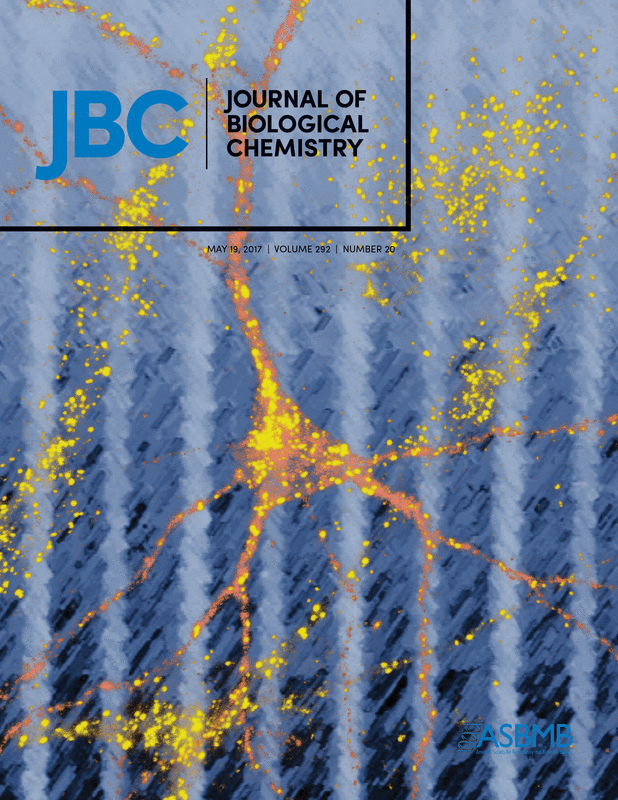
Jocelyn's new review article in the Journal of Neurochemistry is now online. N6-methyladenosine (m6A), the most prevalent internal modification on eukaryotic RNA, modulates transcript stability, splicing and translation efficiency. Activity-dependent m6A in the central nervous system provides a versatile and important mechanism to control RNA structure and function. This review article provides the current knowledge of m6A function and mechanism in neurobiology, highlighting the critical roles of m6A-epitranscriptomic regulation in multiple aspects of the mammalian nervous system, from neural development to plasticity in learning and memory. Tianyi Zhu et al. (Volume 430/3) show that active ubiquitination of FTO mediates its proteasomal degradation, as well as its translocation into the nucleus during nutrient deprivation. The cover depicts an artistic rendition of FTO translocation into nuclei, which are stained by DAPI. The small puncta represent ubiquitinated FTO as revealed by the proximity ligation assay using anti-FTO and anti-ubiquitin antibodies. Cell artwork by Jocelyn Widagdo. Background visual design by Miriam Bucheli (Elsevier/Scientific Editor and Visual Designer). A major collaborative paper led by A/Prof. Bruno van Swinderen (QBI, UQ) has just been published in Cell Reports, describing the effect of a widely used general anaesthetic, propofol, in impairing the presynaptic release of neurotransmitters. Propofol restricts syntaxin 1a mobility on presynaptic membranes, a process that is dependent on another SNARE molecule, SNAP-25. Members of the Anggono Lab who were involved in this study include James Steeves (former Research Assistant) and Shu Liu (former Wen Zhou Scholar). [Press Release] Tianyi, Hilary and Jocelyn have just published a research article in the Journal of Molecular Biology, reporting that the fat mass and obesity-associated (FTO) protein undergoes post-translational ubiquitination at Lys-216 of the N-terminal catalytic domain. By using the CRISPR/Cas-9 approach, they further showed that FTO K216R knock-in cells have a slower rate of FTO protein turnover. In addition, these cells display a defect in FTO translocation into the nucleus following amino acid starvation. Great effort by the team and congrats!
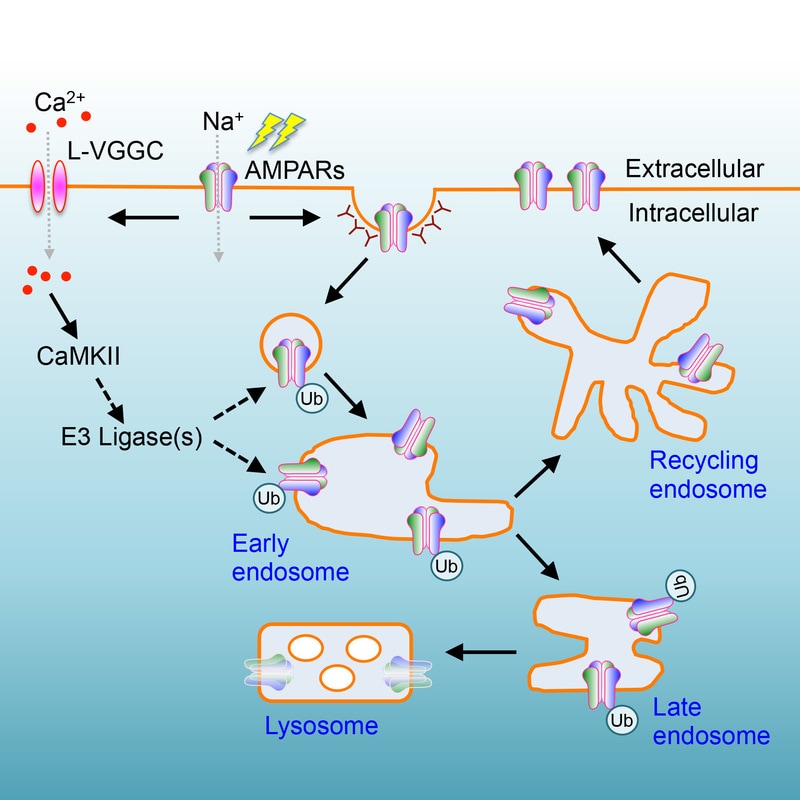
In this article, which has just been published in the Frontiers of Molecular Neuroscience, we review recent advances in the field and provide insights into the role of protein ubiquitination in regulating AMPA receptor trafficking and function in health and disease.
A major work from the Woodin Lab (University of Toronto) has just been published in eLife, in which Victor is a co-author. This is the first report describing the native KCC2 interactome in the brain. They found that KCC2 interacts with PACSIN1 (also known as syndapin1) to regulate synaptic inhibition in neurons.
Activation of GIRK channels by p75 neurotrophin receptors underlies Aβ-induced neuronal death26/7/2017
Joanne and Victor publish a collaborative paper with the Coulson Lab (UQ) in Frontiers in Neuroscience, reporting the role of G-protein-coupled Inwardly Rectifying Potassium (GIRK/Kir3) channels and p75 neurotrophin receptors in mediating potassium efflux during Aβ-induced neuronal death.
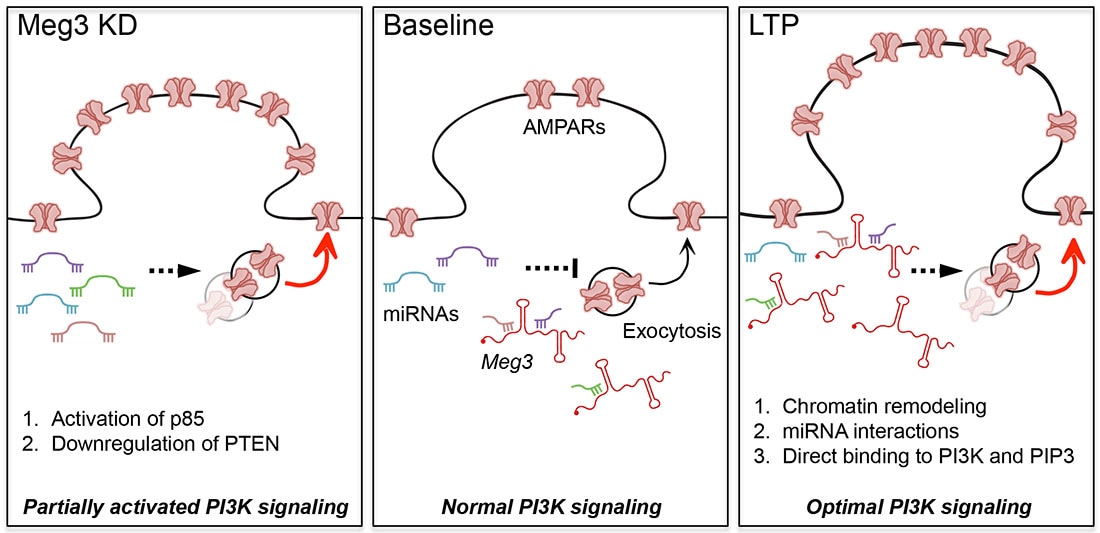
Men Chee, Jocelyn and Tianyi publish their new findings in Frontiers in Cellular Neuroscience, describing a role for the activity-induced long non-coding RNA, Meg3, in modulating the surface expression of AMPA receptors through the PTEN/PI3K/AKT signalling pathway.
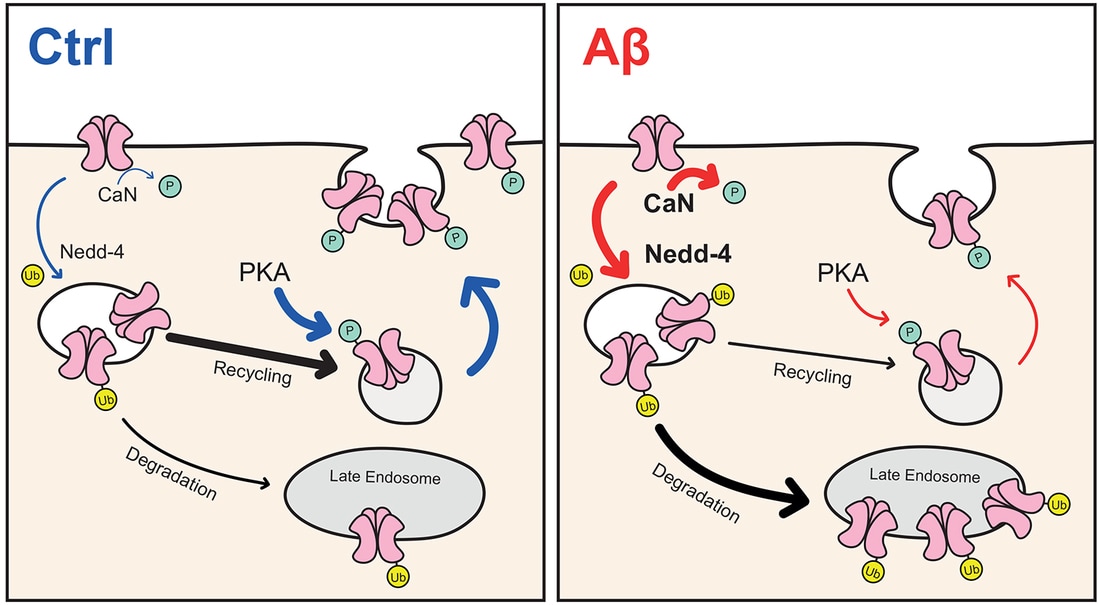
Sumasri, Joanne, Tianyi and Jocelyn publish an article in the Journal of Biological Chemistry, reporting a role for GluA1 ubiquitination in mediating amyloid-β-induced synaptic depression in neurons.
Jocelyn and Victor publish an article in Nature Structural & Molecular Biology, a collaborative paper led by A/Prof. Brett Collins (IMB, UQ). This study reports a mechanism of cargo selection by the unique "electrostatic clamp" in the PDZ domain of sorting nexin 27.
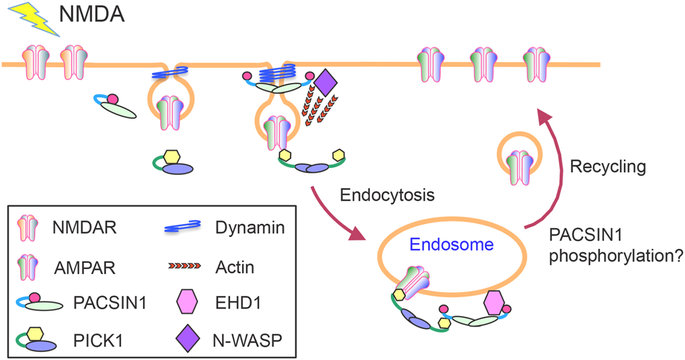
Jocelyn and Joanne publish an article in Scientific Reports, revealing a dual function of PACSIN1 in regulating the internalisation and recycling of AMPA receptors in hippocampal neurons.
Our collaborative work led by Jocelyn is now published in Journal of Neuroscience. This paper provides the first evidence for the dynamic nature of N6-methyladenosine (m6A) modification on RNA in the mouse prefrontal cortex during memory consolidation.
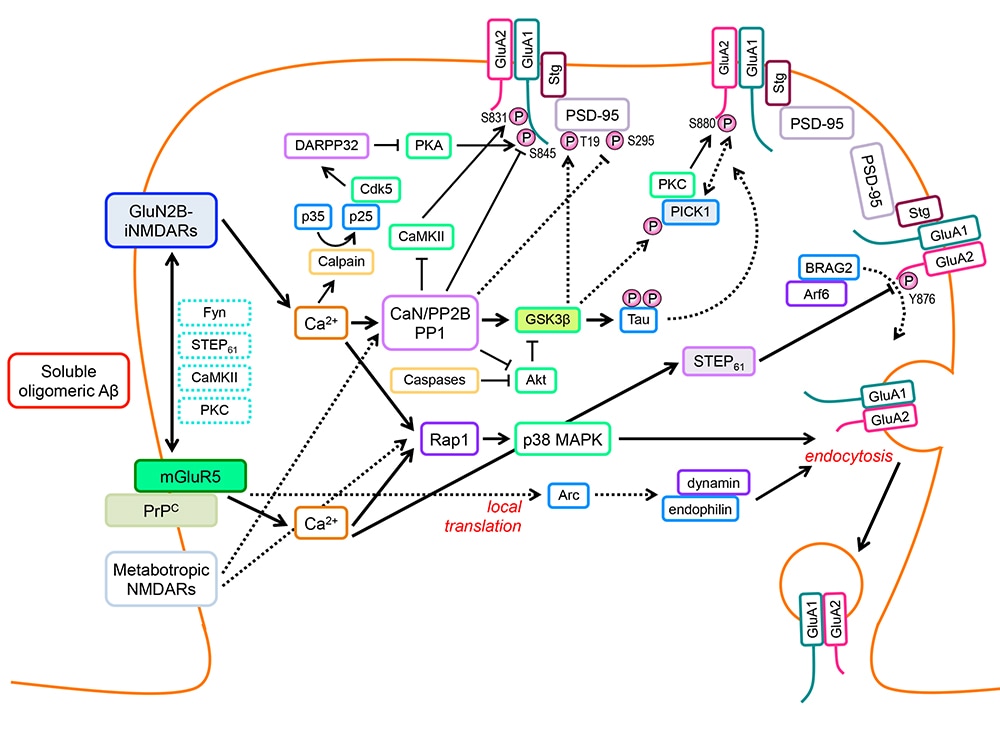
Sumasri and Jocelyn publish an article in Neural Plasticity, reviewing the mechanims underlying dysregulation of AMPA receptor trafficking induced by amyloid-beta.
Victor publishes a paper in Cell Reports describing a novel role for diacylglycerol kinase-theta (DGKθ) in synaptic vesicle recycling
Jocelyn publishes a paper in Human Genetics on the potential role of GTF2IRD1 in chromatin remodelling. This has the implication on our understanding of neurodevelopmental disorder, Williams Beuren Syndrome.
Jocelyn, Ye Jin and Yu Qian publish their research in Cell Reports. Congratulations! [Press Release]
Victor with collaborators in Johns Hopkins publish a paper in Proceedings of the National Academy of Sciences USA on the role of sorting nexin 27 in regulating AMPA receptor trafficking.
|
Synaptic Neurobiology LabArchives
October 2025
Categories
All
|


RSS Feed